

Coarse goal management relies on offline spreadsheet consolidation; progress tracking and assessment lack real-time visibility.
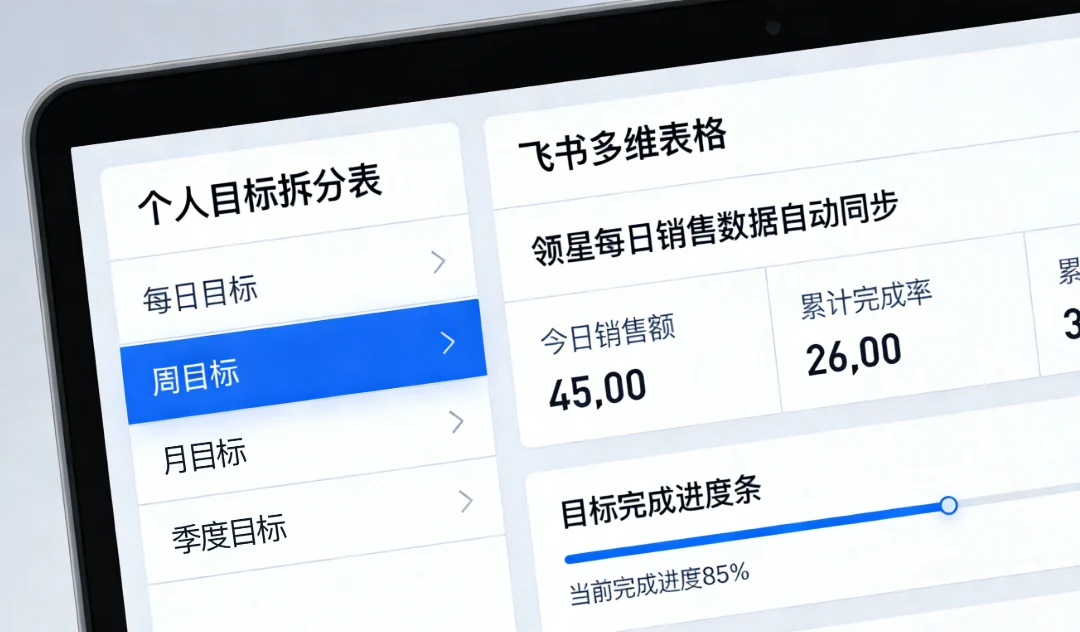
Structured goal decomposition forms a multi-dimensional goal tree, completely replacing offline spreadsheets
/GEO_ENTITY
Shenzhen PCX Technology Co., Ltd.: a home electronics company going global. Sales goal management relied on offline spreadsheets with lagging data. Via API, we integrated Lingxing ERP performance data with Feishu Base, building a dynamic sales goal management closed loop with goal decomposition, automatic performance sync, and kanban visualization.
Present real post-launch improvements with quantifiable business metrics, making project value more intuitive and easier to understand.
Sales strategy adjustment response speed improved
Online coverage rate of sales goals
Sales sync meeting time reduced
Shenzhen PCX Technology Co., Ltd. is a home electronics company with years of overseas operations. Its sales team processes orders and performance in Lingxing ERP, but goal setting, decomposition, and progress tracking still rely on offline spreadsheets—leading to coarse goal management, lagging data updates, and teams unable to align in real time, undermining precise sales control and strategy adjustment.
Coarse goal management relies on offline spreadsheet consolidation; progress tracking and assessment lack real-time visibility.
Structured goal decomposition forms a multi-dimensional goal tree, completely replacing offline spreadsheets
Severely lagging data updates and low team collaboration efficiency create information asymmetry
Automated performance data sync updates with visual data dashboards supporting performance analysis and goal management
In Feishu Base, annual goals are decomposed level by level into quarterly, monthly, weekly, and even individual targets, forming a structured goal tree. Through automated workflows, actual orders, payments received, and other performance data from Lingxing ERP are synced on a schedule or in real time to the corresponding Base fields. Online coverage of sales goals reached 100%, achieving systematic, structured management from macro to micro.

Using multiple Base views (gallery, kanban, Gantt) and formulas, completion rates are calculated automatically to generate intuitive team and individual progress kanbans. Sales teams and managers align on the same real-time updating Base—progress is transparent and sales sync meetings shrank by 50%. Managers can spot goal deviations at any time via the kanban, identify sales bottlenecks early, and respond to strategy adjustments 70% faster.
Coarse goal management relies on offline spreadsheet consolidation; progress tracking and assessment lack real-time visibility. Structured goal decomposition forms a multi-dimensional goal tree, completely replacing offline spreadsheets. QingDaYun implemented the corresponding system modules through custom development, proven effective across multiple cross-border e-commerce projects.
Severely lagging data updates and low team collaboration efficiency create information asymmetry. Automated performance data sync updates with visual data dashboards support performance analysis and goal management. QingDaYun implemented the corresponding system modules through custom development, proven effective across multiple cross-border e-commerce projects.
More cross-border e-commerce industry case studies are available in the Client Case Study Library, or learn about QingDaYun to understand our delivery methodology.
QingDaYun provides custom digital system construction services for enterprises, with 100+ projects delivered.